
As a high school math teacher, I love the summer. It gives me a chance to press the “reset” button after what always seems to be a crazy, emotional roller-coaster of a year. More importantly, it gives me a chance to not “think” about my students for a bit, and selflessly focus on myself. However, what is life like for students during the summer? Yes, most probably go to summer camp, or vacations with their families, but what about students from low-income families? What do their summers look like? I am fortunate to teach in an affluent suburb of Philadelphia, PA. But, this often has me forget that I have students in my classes who may not have these options for summer getaways. I wondered many students do I have that come from low-income families?
Heading to greatschools.org, and looking up my school district, I found that 12% of our students are from low-income families. I roughly teach 125 students per year. Being the math lover that I am, 12% of 125, is 15. Meaning, approximately 15 students of mine each year come from low-income families, and are thus eligible for a free or reduced-price lunch. This got me thinking. What happens to those students who need help getting fed in the summer?
After perusing the data.gov website I landed upon a topic titled “Summer Food Service Participation, Meals, and Costs Data”. The website discusses a program called the Summer Food Service Program (SFSP), also known as the Summer Meals Program for short. This program is run by the U.S. Department of Agriculture (USDA) and is designed to provide children and teens under the age of 18 with free meals in the summer when school is not in session. This program instantly got my attention, and I wanted to know more. Data.gov provides an extensive summary for the article “Summer Food Service Participation, Meals, and Costs Data” and is as follows
During the school year, many children receive free and reduced-price breakfast and lunch through the School Breakfast and National School Lunch Programs. What happens when school lets out? Hunger is one of the most severe roadblocks to the learning process. Lack of nutrition during the summer months may set up a cycle for poor performance once school begins again. Hunger also may make children more prone to illness and other health issues. The Summer Food Service Program is designed to fill that nutrition gap and make sure children can get the nutritious meals they need. This data set contains information on summer food service participation, meals served and cash payments provided by state. (n.p.)
Data Analytics
The SFSP Statistics
From data.gov and then organized by the Tableau application I’ve compiled the data from SFSP about how many students take part in their program each summer, starting from 1969 to 2018. Since this is a wealth of information, I have chosen to include the data in spreadsheet form from 1969-1979 and then from 2009-2018 to compare.
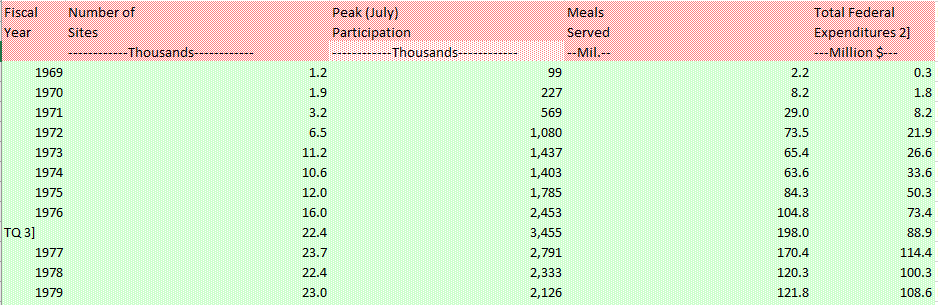
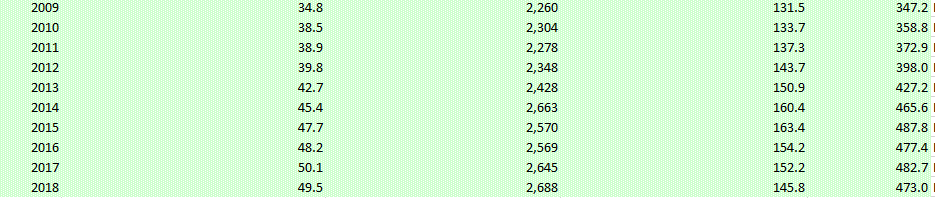
Summarizing and Interpreting the SFSP Statistics
Below are snap shots of the graphs (and links to the interactive graphs) of the data comparing the fiscal year to two different components: meals served and number of sites. Although the total cost shown in the original spreadsheet is an important element, I will focus on the number of meals served and number of sites because this relates to my inquiries. For the graphs, all fiscal years are listed to allow to see the trends over the years.
Overall, the findings are important. Even looking at students who took part in this in this program in 1969 and in 2018, is drastic. The data shows that in 1969 there were 2.2 million meals served, where as in 2018 there were 145.8 million meals given. Thinking about drastic increase, I can see this being the case for many reasons. First, the amount of sites available went from 1.2 thousand sites in 1969 to 49.5 thousand sites in 2019. This means that this program is able to reach more and more children each year. Second, there could be more awareness of this program nearly 40 years after it was started. Lastly, this means that there is a good chance my lower-economic students may be part of this program.
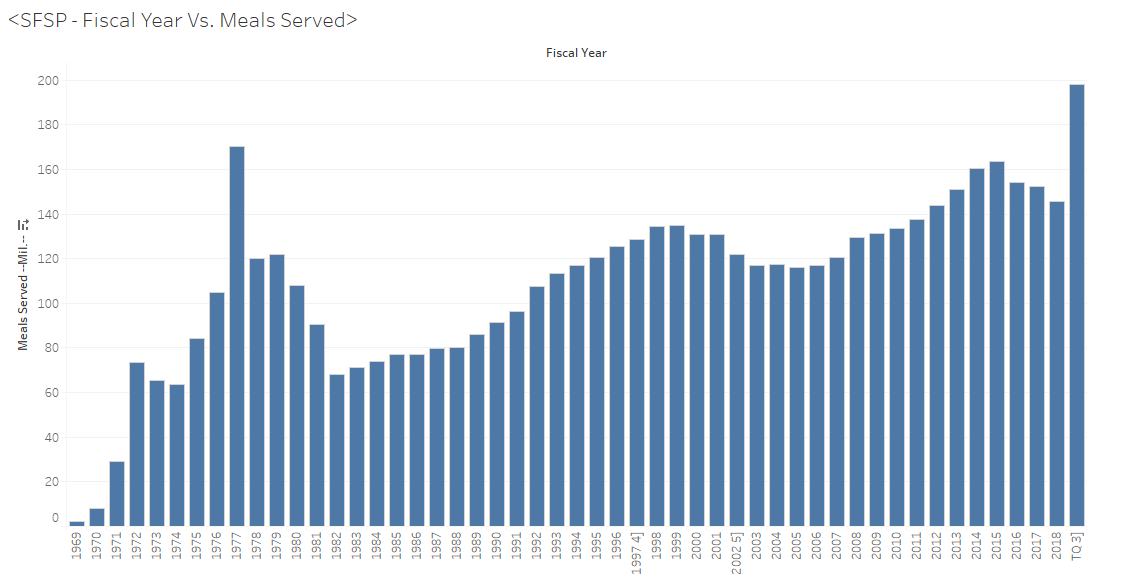
Looking at the bar graph of the Fiscal Year vs. Number of Meals Served above (or clicking here for the interactive graph), there seems to be a spike in 1977. I questioned why this was and what was the implication on the number of meals served. Fortunately, on the sites website they broke down the program history and mentioned specific years that laws or issues came into play that affected the program. For example, with the spike in 1977, according to the “Summer Food Service Program” website on the program history page, the spike in 1977 was due to the introduction of a new law. The P.L. Law 95-166 was put into place in November of 1977 and “required sponsors to provide year-round service, demonstrate the adequacy of their administrative and financial management, and submit complete budgets. Residential camps could only claim meals served to children eligible for free and reduced price meals” (n.p.). With these requirements now set in place, it makes sense that the number of meals served, drastically declined after 1977.
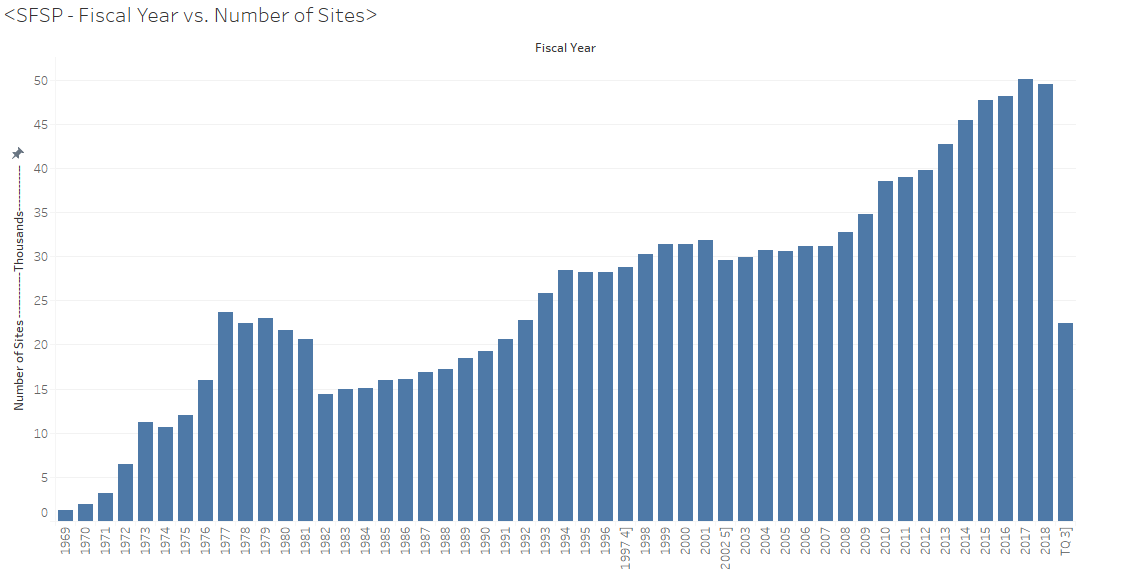
Looking at the bar graphing comparing the Fiscal Year vs. Number of Sites above (or clicking here for the interactive graph), there is a spike in the data from 1977 to 1981. I again wondered why this acquired. Reviewing the “Summer Food Service Program” website and the program history document, there was a specific Act put into place that drastically changed the program:
Omnibus Budget Reconciliation Act of 1981 (P.L. 97-35)
made major changes to the program. The law eliminated
private nonprofit organization sponsors, except for schools
and camps. The law also redefined “area of poor economic
conditions” to mean areas where 50 percent of children
would be eligible for free and reduced price meals, rather
than one-third. Participation dropped from 1.9 million
children at more than 20,500 sites in 1981, to less than 1.4
million children at approximately 14,400 sites in 1982. (n.p.)
Ramifications of the Analysis – Effects of Lack of Nutrition
After realizing that I will most likely have students who come from low-economic families each year, I want to take the time to learn how this lack of food (nutrition) affects their learning. With the new school year approaching, I want to know what symptoms students who come from low-economic families may exhibit. This will help me better be able to help them as their teacher. Previously, I mentioned the summary of the program on the data.gov website, and why this program is vital to students. The data.gov website states that “hunger is one of the most severe roadblocks to the learning process. Lack of nutrition during the summer months may set up a cycle for poor performance once school begins again. Hunger also may make children more prone to illness and other health issues” (n.p.). Moreover, the American Academy of Pediatrics (2015) in their article “Lack of Adequate Food is Ongoing Health Risk to US Children” adds to this by arguing that the “lack of adequate healthy food can impair a child’s ability to concentrate and perform well in school and is linked to higher levels of behavioral and emotional problems from preschool through adolescence” (n.p.). From these descriptions, and through my own research, the following ideas can be summarized from literature when students face food insecurities: poor nutrition, lack of school readiness, ongoing health issues, and poor mental health. These are ideas I will want to keep in mind, when I learn of a student who comes from a low-income family, and may not have access nutritional food on a regular basis.
Nutrition and the Brain
According to the “Summer Food Service Program” website, “another way to increase and maintain regular attendance at summer meals sites is to serve nutritious and appetizing meals” (n.p.). Cuninggim (2014) in the article “The Impact of Nutrition on Learning and Behavior: A No Brainer” acknowledges that it’s not enough that the low-economic children get meals, but that they are nutritious. Cuniggim (2014) argues that feeding children and teens is complicated because it involves “finding the resources to make and buy healthier foods” (n.p.). Cuninggim (2014) gives multiple reasons to while it is vital for children and teens to get a nutritious diet. Overall, Cuninggim (2014) argues that “to focus, remember and regulate our emotions we need protein, unsaturated fats, complex carbohydrates and sugars (in grains, fruits and vegetables), as well as a host of trace elements such as iron, potassium, and selenium” (n.p.).
Lack of School Readiness from a Young Age
Hoxworth (2018) in her article “Brain Food” through Sibylle Kranz, an associate professor of kinesiology and a registered dietitian nutritionist, argues overall that “children who are hungry are not able to focus, so they have a low attention span, behavioral issues, discipline issues in the school” (n.p.). In the article, discussed is the idea that recent studies show that “food security – having reliable access to a sufficient amount of food – could affect learning as early as kindergarten” (Hoxworth, 2018, n.p.). A study done in March of 2018 and published in the journal Child Development, as discussed by Hoxworth (2018) found that “children who experience food insecurity in early childhood are more likely to start kindergarten less ready than children from homes that are food-secure” (n.p.).
Ongoing Health Issues and Poor Mental Health
For students from low-economic families who don’t have access to healthy meals on a regular basis means they are also prevelant for ongoing health issues. In an article by American Academy of Pediatrics (2015) called “Lack of Adequate Food is Ongoing Health Risk to US Children”, argue that “children who live in households that are food insecure, even at the lowest levels, get sick more often, recover more slowly from illness, have poorer overall health and are hospitalized more frequently” (n.p.). The ongoing health issues also includes poor mental health. According to Gellner (2018) in the article “Lack of Food can Affect a Child’s Learning Abilities” he summarizes the mental health issues that can arise for students from food insecurity homes. Gellner (2018) argues that “teens are at higher risk of mood disorders, behavior issues, substance use, and even suicide. Childhood food insecurity can last into adulthood. These adults may not know how to handle stressful situations because they didn’t learn the coping skills they needed to” (n.p.).
Getting Involved
As soon as I saw the statistics after running the reports, I immediately wanted to know how to help. On the program’s website, run by the USDA, lists helpful flyer that gives multiple ways to get involved depending on your interest. Whether you’re an educator, parent, or community member, there are a plethora ways to get involved with SFSP, and similar programs. Listed is everything from why the program exists to discovering ways to recruit children and teens for the program. The flyer can be found by clicking here .
Finding a Location
As soon as I perused the facts sheet and website I was curious to find the closest sites available in my district. Fortunately, the “Summer Food Service Program” website makes this very easy to do.According to the website you can find an SFSP site through the following ways:
- Texting “Summer Meals” to 97779
- Call 1-866-348-6479
- Utilize the Summer Meal Site Finder by clicking the hyperlink
If your area doesn’t have a location, you can work with your community to sponsor one. According to the “Summer Food Service Program”, you can contact the following individuals and tell them about your interest in providing meals to kids in the summer: school principal, The Parent Teachers Association, the school food service manager, school officials, the office of Recreation and Parks, or elected officials.
Want More Information?
If you still have questions after reading this blog, you can find the main website here, an infographic summarizing the program here, and the FAQ’s here.
References
American Academy of Pediatrics. (2015, October 23). Lack of adequate food is ongoing health risk to US children: Nation’s pediatricians release policy statement stressing the importance of federal, state and local nutrition programs to help combat the immediate and potentially lifelong impact of food insecurity. ScienceDaily. Retrieved July 20, 2019 from http://www.sciencedaily.com/releases/2015/10/151023083717.htm
Cuninggim, P. (2014, May 06). The Impact of Nutrition on Learning and Behavior: A No Brainer. Retrieved July 19, 2019, from http://nisce.org/blog/features/impact-nutrition-learning-behavior-brainer/
Gellner, C., Dr. (2018, December 18). Lack of Food can Affect a Child’s Learning Abilities [Interview]. Retrieved July 19, 2019, from https://healthcare.utah.edu/the-scope/shows.php?shows=0_06s5mo3y
GreatSchools.org. (n.d.). Retrieved July 17, 2019, from https://www.greatschools.org
Hoxworth, L. (2018, January 04). Brain Food. Retrieved July 19, 2019, from https://news.virginia.edu/content/brain-food-exploring-connections-between-nutrition-and-learning
Summer Food Service Program. (n.d.). Retrieved July 17, 2019, from https://www.fns.usda.gov/sfsp/summer-food-service-program
Summer Food Service Participation, Meals, and Costs Data. (2019, May 02). Retrieved July 17, 2019, from https://catalog.data.gov/dataset/summer-food-service-participation-meals-and-costs-data
 Alli's Education Blog